
Business-management and financial software
Customers were losing hours to questions the product could already answer, and to administrative tasks that took several screens to complete.
hours seconds
The business
Belgian business-management and financial software for independent workers and small businesses. Its customers are people running their own operations, who hit tax, invoicing, and administrative questions constantly and rarely have someone to ask.
How it worked before
A tax or invoicing question meant searching documentation, or contacting support and waiting.
Answers were not always tied to a source, so a cautious user checked them anyway.
Routine administrative work meant moving between several screens to complete one task.
The customer base spans multiple languages, so support load was multiplied across them.
The knowledge customers needed already existed in the product and in its documentation. It was the retrieval that was expensive, not the information.
Constraints
- Answers about tax and finance must cite where they came from. A confident wrong answer in this domain is worse than no answer.
- The assistant operates on real customer records, so anything with a consequence needs explicit human confirmation.
- The market is multilingual and the experience had to hold up across languages.
- It had to be a production feature inside a live product, not a demo attached to the side of one.
The diagnosis
The difference between a chatbot and something a business can rely on is not the model, it is the boundaries around it. Ground every answer in a real source, let it read the customer's own data, and require a person to confirm anything consequential. Those three constraints are what make it safe to put in front of paying customers.
What went where
- Rules
- The records, the permissions, and the boundaries. What an assistant is allowed to read and change is conventional software, scoped to the permissions the user already has. Nothing about access is left to the model to infer.
- Interpretation
- The language. Understanding a tax or finance question, finding the answer in real sources, working across the market's languages, and turning a request into a proposed action. This is where AI genuinely earns its place.
- Judgment
- Every consequential action. The assistants propose; a person confirms. Creating, changing, or sending anything that touches a customer or a ledger requires explicit confirmation, without exception.
What was built
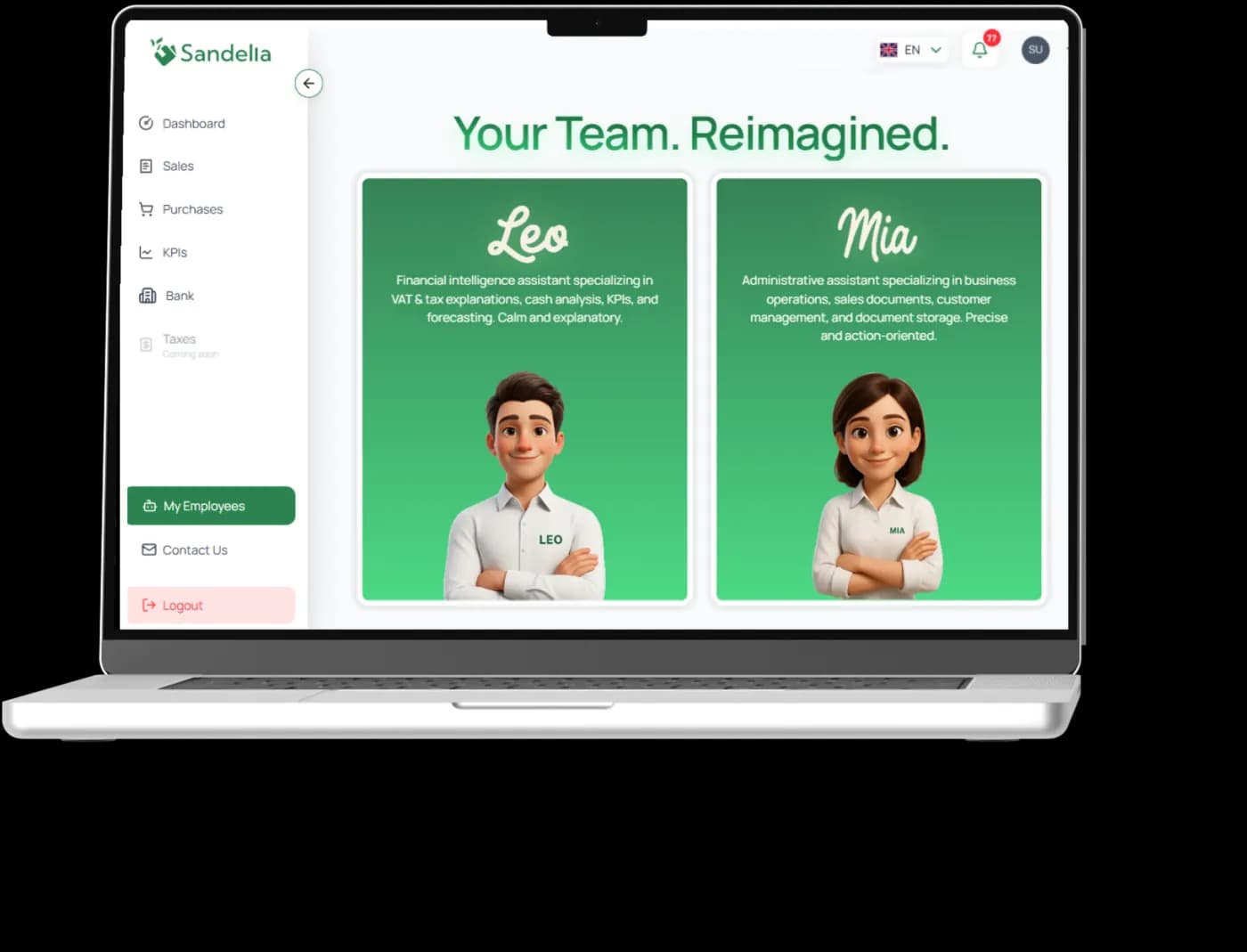
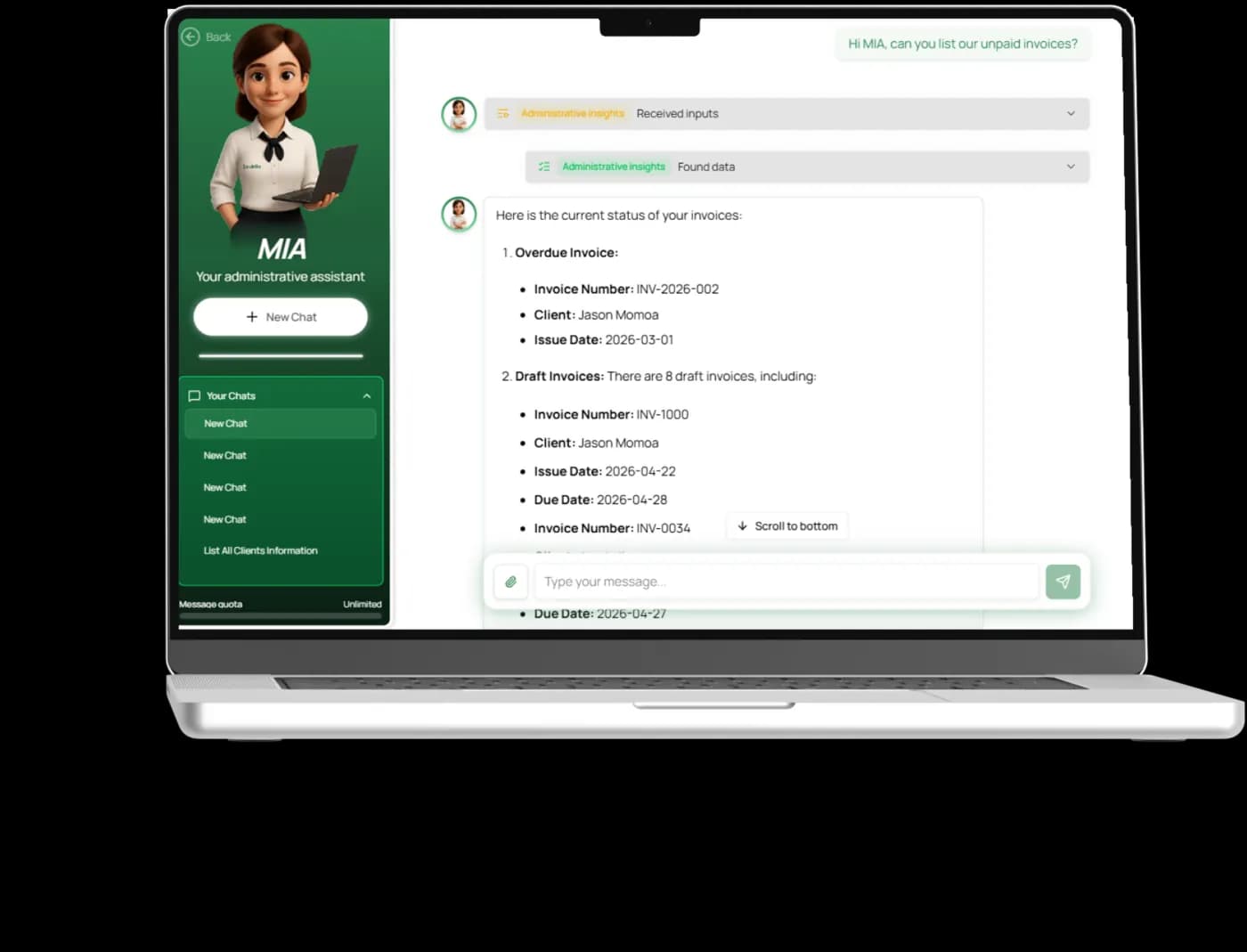
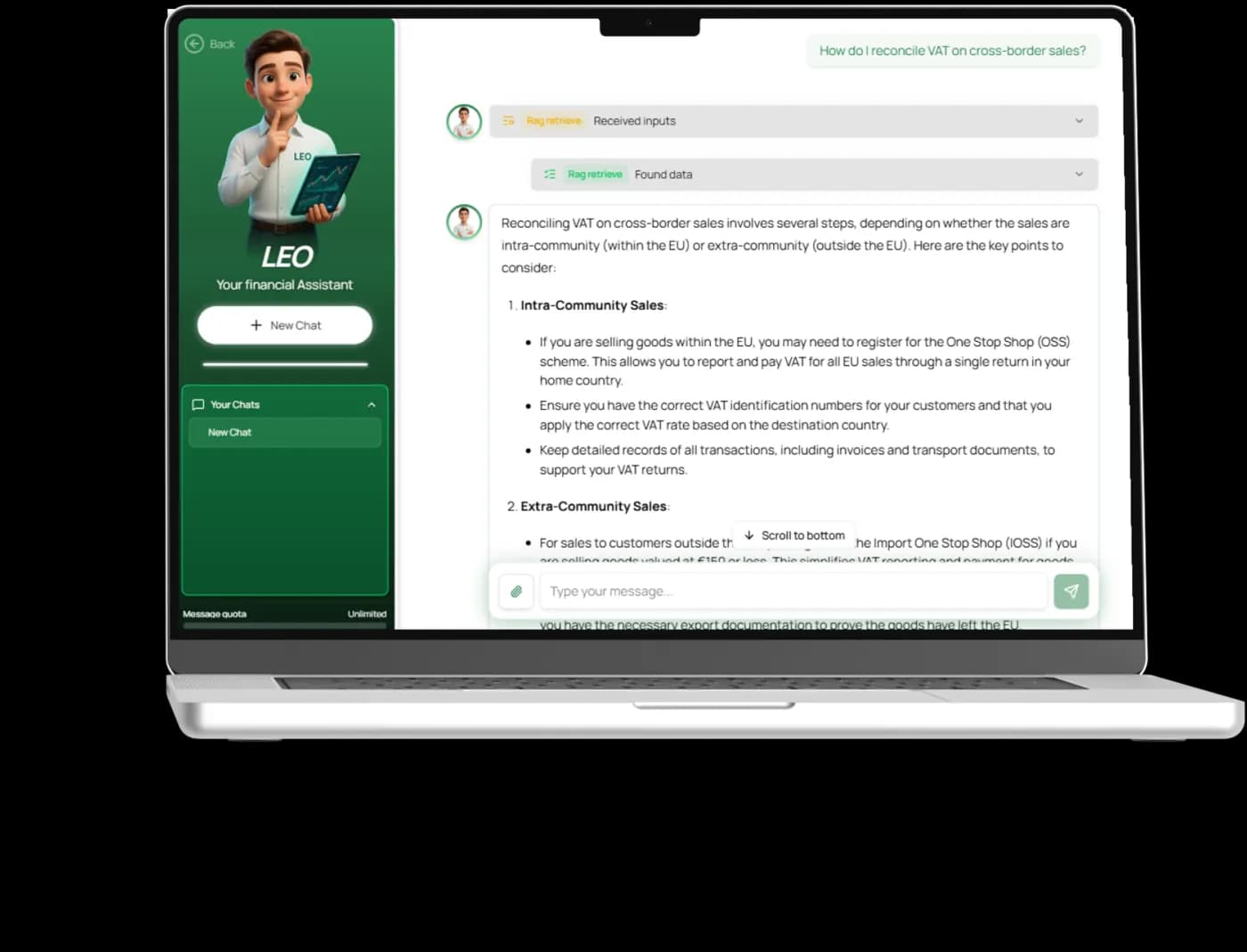
Two AI assistants embedded in the product: Mia, handling administrative work, and Leo, handling accounting. They answer tax and financial questions from sourced knowledge, answer questions about the customer's own records, and carry out work across customers, products, invoices, emails, reminders, and documents, always asking for confirmation before anything consequential. Both work across the languages the market needs.

- Sourced knowledge answers
- Tax and financial questions answered from real reference material, with the source attached so the answer can be checked rather than trusted blindly.
- Questions about your own data
- The assistants can answer questions about the customer's actual records, not just general documentation.
- Actions with human confirmation
- Work across customers, products, invoices, emails, reminders, and documents. Anything consequential is proposed and waits for a person to approve it.
- Two distinct roles
- Mia covers administrative work and Leo covers accounting, so each has a bounded remit rather than one assistant claiming to do everything.
- Multilingual
- The experience holds up across the languages the customer base actually uses.
- Streaming responses
- Answers appear as they are produced, so a longer response does not read as a frozen screen.
What stayed human
- Confirming anything with a consequence
- The assistants can prepare an invoice, an email, or a change to a record, and then stop. A person approves it. This is the boundary the whole feature is built around, not a setting that can be turned off.
- Trusting an answer without its source
- Answers cite where they came from so the reader can check them. In tax and finance a confident wrong answer is worse than no answer, so the judgment about whether an answer is good enough stays with the person reading it.
Results
hours seconds
Common tax, financial, invoice, and administrative questions went from hours to seconds.
90%
90% of supported administrative workflows can be completed in conversation, with confirmation before anything consequential.
Key decisions
Citations are not optional
In tax and finance an unsourced answer is a liability. Requiring a source constrains what the assistant is willing to say, which is the point.
Confirmation before consequence
The assistant proposes, a person disposes. Full autonomy would have demoed better and been unusable in production on real financial records.
Two bounded assistants rather than one general one
Separate remits make the assistants easier to reason about, easier to evaluate, and easier for a customer to predict.
How it was delivered
Grounding the knowledge
Establishing what the assistants are allowed to answer from, and making retrieval reliable enough that citations are real rather than decorative.
Data-aware questions
Letting the assistants query the customer's own records safely, within the permissions that customer already has.
Actions and the approval gate
The supported operations, and the confirmation step that stands between a proposed action and a real one.
Multilingual and production hardening
Language coverage, streaming, and the observability needed to run this as a product feature rather than a prototype.
Is your process stuck in a spreadsheet?
If any of the before-workflow above looked familiar, describe your version of it. You do not need a specification, just the process you are trying to fix.